In the previous post, I found that fitting a model into this laptop’s memory was the easy part. Getting through a large prompt in a reasonable amount of time was harder. Qwen3-Coder-Next beat the smaller 30B model at depth, and prompt processing mattered much more than the generation speed quoted for an almost empty context window.
I went back and tested the settings I had left as hypotheses: quantizing the KV cache, increasing physical batch sizes, and actually filling more of the large context window. After 15 runs and 64 depth measurements, two changes earned a place in my configuration:
- 30B with q8_0 KV: almost twice the prompt throughput at 74K, 24% faster generation, and 5.6 GiB less GTT usage.
- Laguna with physical batch 512: 26–31% faster prompt processing at 40–81K, with essentially unchanged generation speed.
Coder-Next was less decisive. Its larger batches did too little to keep, and its q8_0 result landed almost exactly on my adoption threshold. It also completed a 225K-token prompt. That last result needs a stopwatch alongside the memory figure.
What I measured this time
Same ASUS TUF Gaming A14, Radeon 8060S / gfx1151, 64 GB unified memory, and 56 GiB
GTT ceiling. This run used AC power and the performance profile, Arch/Omarchy,
kernel 7.2.5-3-omarchy, Mesa 26.2.2-1, LM Studio 0.4.24-2, and its Vulkan
llama.cpp runtime 2.41.0.
The weight files stayed fixed:
| Model | Unsloth GGUF |
|---|---|
| Qwen3-Coder-30B-A3B-Instruct | UD-Q6_K_XL |
| Qwen3-Coder-Next | UD-IQ4_XS |
| Laguna S 2.1 | UD-Q2_K_XL |
q8_0 below means the K and V cache format. I did not replace the model weights with a different quantization.
Each run started with a fresh model load, a ten-second settling period, and prompts in increasing depth order. Models were unloaded between runs, with 150 seconds of cooling before the next. Requests were sequential, even when a model was configured with multiple parallel slots.
I measured prompt processing (prefill) and token generation (decode) from the server’s timing logs. These replace the client-side timing method in the first post. The synthetic code filler used seed 7; requests used temperature 0.7 and an output limit of 300 tokens, with generation seed unfixed. Two outputs ended a little early; rates use the actual token counts.
Each model’s baseline was measured twice. I compared variants with that mean and treated differences below the larger of 5% or the baseline spread as noise. That is a practical selection rule, not a statistical confidence interval. Most variants had one pass; the borderline Coder-Next cache setting received a repeat.
Nearly the entire prompt was evaluated at every point. The 30B reused a 20-token prefix after the first depth, at most 0.22% of a prompt. Everything here therefore describes processing a substantially new prompt. It does not measure the benefit of reusing a large cached conversation prefix.
That also corrects my earlier wording about paying the full prefill cost “every turn.” These measurements establish the cost when the prompt must be evaluated; they do not establish how much work a particular coding client and server can reuse.
The percentages below compare fresh baselines and variants from this session. Comparing them directly with September 11 would mix the tuning changes with differences in measurement method and configuration.
30B: the cache change was worth keeping
The cleanest result was Qwen3-Coder-30B. Switching both K and V from f16 to q8_0 reduced load GTT from 37.28 to 31.66 GiB. Peak usage in the q8_0 run was 31.86 GiB.
Throughputs below are tokens per second. Baseline columns are the two-run means.
| Actual tokens | f16 prefill | q8 prefill | f16 decode | q8 decode |
|---|---|---|---|---|
| 1,197 | 832.7 | 878.1 | 60.6 | 60.6 |
| 9,250 | 740.1 | 802.1 | 47.4 | 48.9 |
| 37,171 | 313.4 | 419.7 | 29.0 | 34.4 |
| 74,385 | 124.7 | 247.1 | 19.5 | 24.2 |
At 74K, prefill improved 98.2% and decode improved 24.0%. Prompt processing fell from about ten minutes to five. That still feels long at a keyboard, but it is a substantial improvement from one setting that also frees memory.
The gain grows with context depth. Short-prompt generation is essentially unchanged. This is why testing the cache setting only on a small prompt would have missed its value.
I kept q8_0, flash attention, batch 2048 / physical batch 512, a 131,072-token configured window, and one slot. The deepest prompt tested for this model was 74K; the configured window is larger than the workload validated here.
The crossover is a band, not a magic token count
The faster 30B made it worth checking where Coder-Next takes over. I added two matched depths with the selected configurations, 30B q8_0 and Next f16.
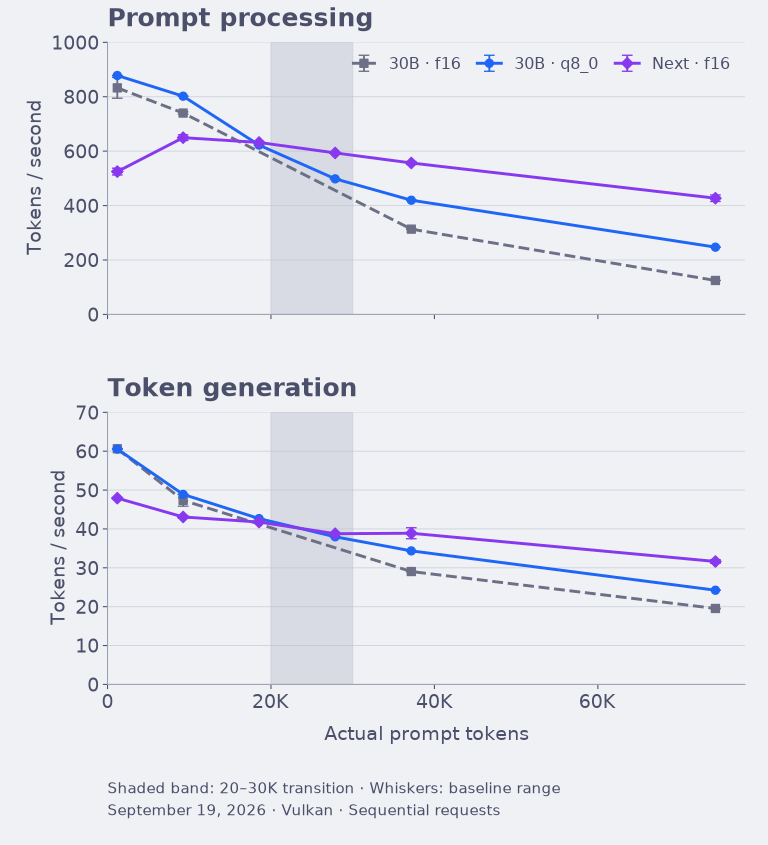
The baseline points in the chart are two-run means, with whiskers showing the observed range. The q8_0 series and added midpoint checks are single measurements. Lines connect measured points; they are not a fitted model.
| Actual tokens | 30B prefill | Next prefill | 30B decode | Next decode |
|---|---|---|---|---|
| 18,542 | 622.3 | 631.9 | 42.7 | 41.8 |
| 27,853 | 498.2 | 593.5 | 38.0 | 38.8 |
At 18.5K, both metrics are within 5%. At 27.9K, Next processes the prompt 19.1% faster, while generation still ties by that rule. By 37K, Next clearly leads in both, and its lead grows at 74K.
My practical choice is now 30B for short prompts, a 20–30K transition band, and Next around 28K or deeper when feeding it substantial new context. The old rough 20K switching heuristic was useful; the measurements do not support an exact cutoff. This is a speed comparison, not a ranking of coding ability.
Coder-Next: a borderline cache result, and no batch upgrade
For Next, my predeclared rule required at least an 8% decode improvement at 74K, without a prefill regression greater than 5% at any shared depth.
After two q8_0 measurements, the 74K decode mean went from 31.62 to 34.12 tok/s: 7.89% faster. Prefill fell 2.35% there, and the largest shared-depth prefill regression was 4.38%. It met the prefill condition and narrowly missed the decode condition, so I retained f16.
The difference between 7.89% and 8% has no special physical meaning. It is a threshold decision, and a sensitive one. A later f16 confirmation measured 30.88 tok/s at 74K, which would shift the comparison if folded into the baseline. I kept that confirmation separate from the original two-baseline/two-variant selection and retained all measurements in the data.
There are good reasons to revisit q8_0 for a workload dominated by long-context generation: it saved roughly 2.8 GiB, and the single 149K measurement generated at 29.35 tok/s versus the f16 baseline mean of 24.57, a 19.4% improvement. I did not repeat q8_0 at that depth or extend it to 225K. Calling it a failed optimization would overstate the evidence.
Increasing physical batch size was less interesting. With q8_0 held constant, physical batches of 1024 and 2048 both completed 149K without GPU errors. Neither met the required 10% deep-prefill improvement over physical batch 512. The 1024 setting gained about 9%, 8%, and 2% at 37K, 74K, and 149K; 2048 gained about 2% at each. More memory for little consistent benefit.
Next therefore stays on f16 KV, batch 2048 / physical batch 512, four slots, and a 262,144-token configured window.
Laguna: physical batch 512 works in this configuration
The first article included a Laguna GPU hang with f16 KV, logical batch 2048, physical batch 512, and four slots on an older runtime. My working fallback used q8_0, logical batch 512, physical batch 256, and two slots.
This time I kept that fallback’s other settings and changed only physical batch from 256 to 512.
| Actual tokens | 256 prefill | 512 prefill | Gain | 512 decode |
|---|---|---|---|---|
| 1,334 | 261.8 | 343.2 | 31.1% | 39.7 |
| 10,118 | 288.8 | 392.9 | 36.0% | 37.9 |
| 40,535 | 251.1 | 329.5 | 31.2% | 32.1 |
| 81,068 | 210.1 | 264.3 | 25.8% | 27.0 |
| 121,704 | untested | 226.5 | no baseline | 23.0 |
Generation differences at the shared depths stayed below 5%. The benefit is faster prompt ingestion. Load GTT increased only from 44.28 to 44.62 GiB, and the deepest run peaked at 45.12 GiB.
That is enough to adopt physical batch 512 with q8_0, logical batch 512, two slots, and runtime 2.41.0. It does not prove the old crashing combination is safe, or isolate which difference prevented the old crash.
Laguna tokenizes this synthetic prompt differently from the Qwen models, which is why its actual token counts differ. These comparisons stay within Laguna. Although thinking was enabled, all its responses reported zero reasoning tokens, so this does not establish performance on extended reasoning workloads.
225K fits. Reading it takes 17.6 minutes.
The selected Coder-Next configuration completed a prompt containing 224,842 actual tokens. Prefill was 213.21 tok/s, generation was 20.12 tok/s, and peak GTT was 43.15 GiB. No GPU kernel errors were observed.
The server spent 1,054.5 seconds, or 17.6 minutes, processing that prompt before generation. The following 300 tokens took about 15 seconds.
In the first article I described doubling the configured window as costing memory and “nothing else,” based on a shallow-prompt comparison. That needs a narrower claim: reserving a larger window did not meaningfully change shallow decode in that test. Filling the window has a substantial cost. The new 225K measurement puts a number on it.
A short client timeout can end such a request before the model starts answering. For my workload, trimming the new context sent on a turn remains valuable even when the full prompt fits comfortably in memory.
TL;DR: recommended configurations for programmers
For programming on this 64 GB Strix Halo laptop, I would start with 30B for focused edits, small code questions, and short prompts. Use Coder-Next for larger repository context, especially around 28K tokens and deeper when sending substantial new code. Around 18.5K they effectively tie; treat 20–30K as a transition band, with the choice depending on how much new context each turn needs to process.
These are the presets I would keep in LM Studio. Batch sizes below are logical / physical, and the context column is the configured window, not the deepest prompt tested.
| Model | K/V cache | Logical / physical batch | Configured tokens / slots |
|---|---|---|---|
| 30B | q8_0 | 2048 / 512 | 131,072 / 1 |
| Coder-Next | f16 | 2048 / 512 | 262,144 / 4 |
| Laguna | q8_0 | 512 / 512 | 262,144 / 2 |
The weight quants remain UD-Q6_K_XL for 30B, UD-IQ4_XS for Coder-Next, and UD-Q2_K_XL for Laguna. The cache column refers only to K and V. Use the Laguna preset if Laguna already suits your coding workflow: increasing physical batch to 512 makes large prompts faster to ingest. These tests do not rank the models’ coding ability.
For planning memory and waiting time:
- 30B: about 31.9 GiB peak GTT, tested through 74K. The clearest tuning win was q8_0: nearly twice the prefill throughput and 24% faster generation at that depth.
- Coder-Next: about 43.2 GiB peak GTT, tested through 225K. Keep f16 as the selected default; q8_0 remains a candidate for workloads dominated by long-context generation. Do not expect interactive turnaround when ingesting 225K new tokens: prefill alone took 17.6 minutes.
- Laguna: about 45.1 GiB peak GTT, tested through 122K. Keep q8_0 and batch 512 / 512 with two slots; the measured gain is faster prompt processing, with generation speed essentially unchanged.
For a coding assistant, send the files and excerpts needed for the current task, preserve reusable prompt prefixes where your client supports it, and allow enough request time for large uncached prompts. The largest available context window does not need to become the default amount of code sent on every turn.
All three use Vulkan and flash attention. After the benchmarks, I also made Coder-Next’s sampling defaults explicit: top_p 0.95, top_k 40, repetition penalty disabled. Those changes were applied afterward, so they did not contribute to the reported tuning gains.
Across the matrix, no GPU timeouts, resets, or device-loss errors were observed. GTT was sampled every two seconds, with a 50 GiB stop condition; the highest sample was 45.12 GiB. This is evidence for the tested workloads and configurations, not a guarantee for every prompt or concurrent load. I did not benchmark a third-party fork, rerun ROCm, or evaluate answer quality and long-context recall.
The first post’s practical lesson still holds: a large memory ceiling tells you what can load, while prompt depth tells you whether you will enjoy using it. This round adds two settings worth keeping, a better model-switching rule, and an actual measurement of how long an enormous context takes to read.
The complete measurement data includes all 15 runs and 64 points, server token counts and timings, memory measurements, and the tested variants. The chart script rebuilds the figure from that data.
AI usage disclosure
Codex GPT-6 Astra conducted the benchmark tests on my laptop, collected and analyzed the results, and helped me write and edit this post.